The choral symphony
9 Nov 2026
News Story
This article is part of a series in which we consider different aspects of the symphony – not least among which are those with voices.
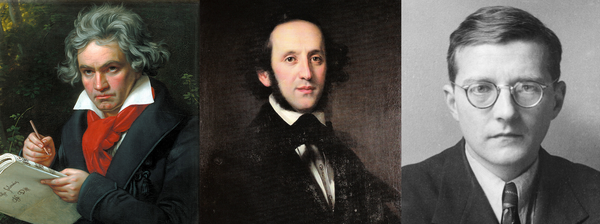
Inevitably, it all goes back to Beethoven: his Symphony No.9 marks the culmination of a cycle which, in retrospect, was building towards the unprecedented inclusion of voices in a symphony. The sense of progression isn't always linear – the Fourth and Sixth (Pastoral) are more intimate than the grand statements of their immediate predecessors – but his ambitions grew in parallel with his confidence in the genre. Schiller’s Ode to Joy (a text the composer had long intended to set to music) made a very fitting finale both to the Ninth and Beethoven's symphonic oeuvre.
It also added considerably to the challenge for later composers. Beethoven had constantly pushed the envelope in his music, and it took some time for the wider musical world to catch up. It wasn’t until the 20th century that the choral symphony – that is, one written for voices as well as orchestra – became a recognised subgenre of the symphony. In the meantime, it seemed only right that Beethoven’s Ninth (not just a choral symphony but THE Choral Symphony) stood apart as a separate entity.
Which isn’t to say that other composers didn’t try their hand at it in the meantime. In his Romeo and Juliet (1839), Berlioz has the bulk of Shakespeare’s plot told by the orchestra, with the voices are used sparingly until the finale. The music owes a clear debt to the Choral, but Berlioz’s nature as a progressive is clear, pushing at the boundaries in what was the first post-Beethoven choral symphony. Among its most profound admirers was Wagner, who would later send Berlioz a personally inscribed copy of his Tristan and Isolde expressing his gratitude.
Contrast this to his opinion on Mendelssohn’s Symphony No.2 (Lobgesang, or Song of Praise), completed only the following year: “why shouldn’t ‘the Lord God’,” Wagner wrote in his 1849 essay The Artwork of the Future, “be praised at the top of one’s lungs at the end [of a choral symphony], after He has skilfully helped bring three instrumental movements into being?” Their music alone suggests that these were two composers destined not to see eye-to-eye, but Wagner’s contempt for Mendelssohn was undoubtedly coloured by his antisemitism, which would not allow him to see the qualities of the Lobgesang. (You can hear them for yourself in The Magic of Mendelssohn, 26-27 November).
Mendelssohn himself put a little distance between his symphony and Beethoven’s precedent, designating the Lobgesang a Symphony-Cantata. This makes it something of a hybrid: the closing cantata can – and sometimes is – performed on its own, but the symphony would be incomplete if played without its choral finale, and placing it within this wider context enriches it no end.
The central musical theme is all the more powerful for being introduced earlier: it’s heard at the very outset of the work, as a trombone fanfare which goes on to underpin much of the opening movement. After appearing more sporadically in the second and third movements, its return as the choral finale gets underway immediately feels significant. Now revealed as the music for the work’s key message (‘let everything that has breath praise the Lord’, the chorus sings), it truly blossoms, setting the seal on the Lobgesang’s optimism.
Like Berlioz’s Romeo and Juliet, Liszt’s choral symphonies are both inspired by literature, but continue in Mendelssohn’s vein by using the voices to convey a spiritual message. The Faust
symphony (based on Goethe) culminates in the title character being saved from eternal damnation, while a distant vision of heaven is glimpsed at the end of the Dante, which takes the portrayal of Hell and Purgatory in The Divine Comedy as its inspiration. Several other composers have followed suit in evoking the divine in their own choral symphonies. Mahler did so twice, in his Symphonies Nos.2 (Resurrection) and 8 – including another setting of the final scene of Goethe’s Faust – while more recently, MacMillan gave his Symphony No.5 the title Le grand Inconnu (‘the great unknown’), in reference to its exploration of the Holy Spirit.
Das Ewig-Weibliche
Zieht uns hinan.
At the more secular end of the spectrum, composers’ reading habits continued to feed into their choral symphonies. To name but three examples, Sibelius turned to the legends of his native Finland in Kullervo, Rachmaninov’s The Bells was his response to Edgar Allen Poe, while Britten’s love of English poetry resulted in works including his Spring Symphony. It’s also worth noting Shostakovich, whose cycle of 15 symphonies serves as a chronicle of 20th-century Russian history: the choral ones alone are reflections on the October Revolution (No.2), the celebration of the Day of International Workers’ Solidarity on 1 May (No. 3) and various aspects of Soviet life and history (No.13, sometimes known as Babi Yar). No.14, a setting of several poems on the theme of death, is not technically speaking a choral symphony but belongs to a subset, with only one voice over and above the orchestra. (Other examples include Mahler’s No. 4 and Gorecki’s No.3, Symphony of Sorrowful Songs.)
By and large, however, a choral symphony implies something envisioned on a scale only achievable through the addition of voices to the orchestra. The use of a specific text generally makes the message of the music that more explicit, leaving little doubt as to the composer’s intentions. This can range from the humanitarian (as in the Choral Symphony itself) to the polemic – the text of Michael Nyman’s No.11, Hillsborough Memorial, includes the names of the 96 Liverpool FC fans who died in the 1989 disaster – but in nearly every case, you can be sure to be left profoundly moved.
Related Stories

Craigmillar Residency Shortlisted for Three Awards
5 November 2026
Our five year Craigmillar Residency has been nominated for three awards!
"A merry Christmas to us all, my dears": SCO concerts for the Bob Cratchit in your life
2 November 2026
Put on your best (worst?) Christmas jumper and join the Orchestra as we celebrate the festive season!
"Bah! humbug": SCO concerts for the Scrooge in your life
2 November 2026
Do tinsel and mince pies leave you cold? There are still plenty of SCO concerts to suit you as the festive season looms ...