Musical layer cakes
20 Jul 2026
News Story
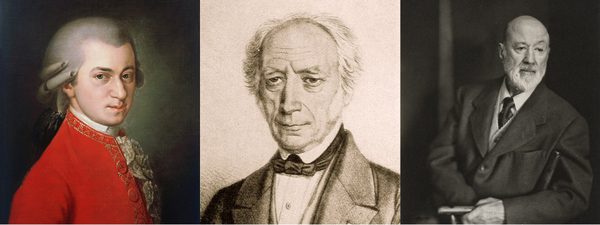
Three seriously clever composers: (left to right) Mozart, Raimondi and Ives
Multiple pieces of music designed to be performed at the same time – that’s got to be asking for trouble. Surely the only possible outcome is cacophony, if not utter chaos?
The answer isn’t as clear-cut as you might expect. The SCO’s performances this summer include Mozart’s Don Giovanni (on 16 August, at the Edinburgh International Festival), in which one scene depicts a party at the title character’s residence. How does the composer convey this in music? He has three on-stage ensembles playing different dances at the same time. Each one has rhythms that are at odds with the others, to say nothing of the potential for clashing harmonies … and yet, somehow, the result is easy on the ear from beginning to end, as you’d expect from any other piece of Mozart. (He even finds room within the score for these musicians to tune up, and if that’s not showing off, we don't know what is.) The entire sequence lasts about two minutes, which may not sound like much, but the technical skill required to make these three dances work both individually and together is frankly mind-boggling.
Given the sort of mindset required for writing music like this, it’s understandably something few other composers have attempted. Bach achieved something along these lines in his Concerto for four harpsichords – a transcription of a Vivaldi concerto for four violins, to be fair, but changing the solo instruments to keyboards means there are that many more notes being played at any one time. When these are on multiple harpsichords (whose sound is produced by the plucking of strings), the resulting percussive effect borders on the hypnotic, almost anticipating the minimalist music of Steve Reich and Philip Glass.
Grieg adopted a slightly different approach, by superimposing his own music on top of someone else’s – in this case, Mozart piano works. The original is left untouched, but the addition of a second piano part flavours it rather unexpectedly: it’s still Mozart, with what one critic has described as ‘a side of gravlax’. Grieg enriches the harmonies, mostly to rather charming effect – except in the case of the Fantasia in C minor, a piece whose drama is heightened thanks to some alarming harmonic crunches that are anything but Mozartean.
You might wonder what possessed Grieg to do such a thing. Put simply, it gave him something to do when giving piano lessons. Once a pupil had got to grips with the Mozart and was working on interpretation, it’s easy to imagine Grieg, sitting at a second piano, giving a running commentary – echoing a phrase in the original, perhaps, or adding some unexpected harmonies. They’re not played very much, but for the curious pianist, there’s always the temptation to get hold of Grieg’s sheet music, put on a favourite recording of the Mozart and play along. You might call it glorified karaoke.
If Grieg’s music is not intended to stand on its own, Milhaud had entirely different ambitions when he wrote a pair of string quartets in the late 1940s. He already had thirteen to his name, and approached his Nos.14 and 15 as pieces that could be played both separately and together, as a string octet. Unlike Don Giovanni, where Mozart could have compromised on the quality of the individual dances – the overall effect being much more important – Milhaud had to ensure the two individual quartets sounded like complete pieces in their own right before combining them.
Which brings us on to a composer whose magnum opus took this to extremes. Pietro Raimondi (largely forgotten today) specialised in structuring works just like this. Active in the first half of the 19th century, he gave opera a wide berth after realising he couldn’t compete with Rossini and turned instead to religious works. In 1848, he unveiled three oratorios: Putifar, Giuseppe and Giacobbe (the Old Testament characters Potiphar, Joseph and Jacob respectively), which were – you guessed it – designed for performance both individually and all at once. A 1852 performance of the full set, first separately, then together, required a total of 430 performers and lasted 6 hours. Take a moment to imagine shepherding all these musicians over a concert of that duration, to say nothing of keeping the Musicians’ Union happy, and you might start to gain a small insight into what Raimondi took on with the composition of this behemoth.
Charles Ives sits slightly apart from this: when he creates the effect of several pieces of music being played simultaneously, their conflicting against each other is very deliberate. In Putnam’s Camp, Redding, Connecticut (the second of his Three Places in New England), for instance, it suggests two marching bands being heard from different directions. Far from attempting to hide the fact their music does not fit together, Ives makes a feature of this. Theoretically, it may be easier to write than Raimondi’s triple oratorio, but the music still has to make sense, to the musicians as well as the audience.
Which is not to say that Mozart made life any easier for himself in Don Giovanni. However you look at it, writing music for three dance bands to play simultaneously is a bit mad …
Related Stories
Classical music on the silver screen
14 October 2026
Join us as we take a close look at the filmic connection in several of our forthcoming concerts.
Craigmillar Residency Shortlisted for 2026 SURF Awards
28 September 2026
The Craigmillar Residency has been shortlisted for the 2026 SURF (Scotland's Regeneration Forum) Awards
Bogdan Božović: "I felt a lot of love and support on the Summer Tour"
15 September 2026
A warm welcome to the Orchestra's new Co-Leader!