Classical music on the silver screen
14 Oct 2026
News Story
The birth of cinema is generally dated 28 December 1895, when the Lumière brothers presented a set of ten short films (all under a minute long) in Paris. Whether this was accompanied by any music has not been firmly established (there may have been a pianist), but it has been suggested that musical accompaniment took hold for practical reasons: projection equipment could be very noisy, and music could serve as a quick fix to drown it out. Either way, as the new medium gradually caught on, live musical accompaniment became increasingly popular. A pianist would typically improvise music, responding to the action on screen, but if a full orchestra was used, pre-existing music was the norm.
It was not until 1908 that a film was first screened with a soundtrack written specifically for the purpose – by no less a figure than Saint-Saëns, then in his 70s. The prestige of L’Assassinat du Duc de Guise (The Assassination of the Duke of Guise), a historical drama, may well account for the choice of a respected composer rather than some young whipper snapper, but it also serves as proof of Saint-Saëns as an innovator. Even as an establishment figure, he was happy to take on new challenges.
Other composers jumped on the bandwagon, and the use of pre-existing music slowly fell by the wayside. Epics seems particularly to have benefitted from tailor-made film score, from 1914’s notoriously racist The Birth of a Nation to Metropolis and Napoleon, both dated 1927 – the same year as The Jazz Singer heralded the advent of sound. By the following decade, the rise of Nazism led to an important number of European composers finding work in Hollywood, among them Steiner and Korngold, perhaps best known for their scores to King Kong (1933) and The Adventures of Robin Hood (1938) respectively.
In 1940, Walt Disney’s Fantasia put pre-existing music front and centre again, with a series of seven vignettes built around well-known classical pieces. It’s worth highlighting the sheer variety of music chosen for this, from Mickey Mouse in Dukas’ The Sorceror’s Apprentice to the evolution of life on Earth in Stravinsky’s The Rite of Spring (a decidedly avant-garde choice at the time). Coincidentally, Stanley Kubrick would adopt a similar approach in his 1967 sci-fi masterpiece 2001: A Space Odyssey, the soundtrack of which employs both popular classics – the opening of Richard Strauss’ Also sprach Zarathustra and Johann Strauss II’s Blue Danube Waltz among them – alongside music by Ligeti, composed that same decade.
Fantasia was something of a one-off, but despite the amount of music written specifically for the screen, the practice of using a carefully-chosen existing work has never quite died out. If we take Mozart alone, the aria Il mio Tesoro (from Don Giovanni) is central to the 1949 Ealing comedy Kind Hearts and Coronets, while his Piano Concerto No.21 is sometimes still nicknamed ‘Elvira Madigan’ following its use in a 1967 Swedish film of the same name, and the score of Sydney Pollack’s 1985 romantic drama Out of Africa is remembered as much for John Barry’s Oscar-winning music as it is for featuring Mozart’s Clarinet Concerto.
The practice has continued using carefully selected music, often to devastating effect. Barber's Adagio for Strings (a work you can hear from the the SCO on 29-30 Oct) adds to the emotive content of The Elephant Man in 1980 (based on the life of Joseph Merrick) and the 1986 Vietnam War drama 1986 Platoon, while the unsettling atmosphere of Bartók's Music for Strings, Percussion and Celeste (played by the Orchestra on 3-4 Dec) pervades both Kubrick's The Shining in 1980 and the surrealist Being John Malkovich (1999). More recently, the climax of The King's Speech (2010) - in which Geoffrey Rush's speech therapist takes on the mannerisms of a conductor as he coaxes George VI through a vital radio speech - is underscored by Beethoven's Symphony No.7, but of late, the lines have started to blur.
Just as Jonny Greenwood straddles the worlds of rock (as lead guitarist in Radiohead) and film music (with soundtracks including There Will be Blood and We Need to Talk About Kevin to his name), so Max Richter has emerged as a prominent composer both on the concert stage and the silver screen. After hovering on the edges of arthouse cinema (with scores including Arrival and 2018’s Mary Queen of Scots), he struck gold with Hamnet in 2025, receiving nominations at the Oscars, Golden Globes and BAFTAs. In the meantime, his seminal Recomposed: Vivaldi – The Four Seasons (which the Orchestra performs in Max Richter+ on 22-23 Oct) has burst from the confines of the classical world to find popularity on TikTok, perhaps the highest accolade pop culture has to offer.
Explore music from the silver screen with the SCO
Related Stories
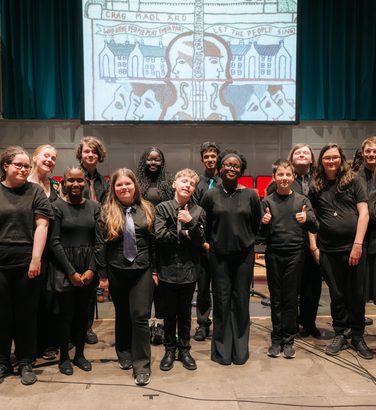
Craigmillar Residency Shortlisted for 2026 SURF Awards
28 September 2026
The Craigmillar Residency has been shortlisted for the 2026 SURF (Scotland's Regeneration Forum) Awards
Bogdan Božović: "I felt a lot of love and support on the Summer Tour"
15 September 2026
A warm welcome to the Orchestra's new Co-Leader!
The Bach revival
7 September 2026
How did the St Matthew Passion come to be forgotten? Join us as we take a deep dive into its history ...