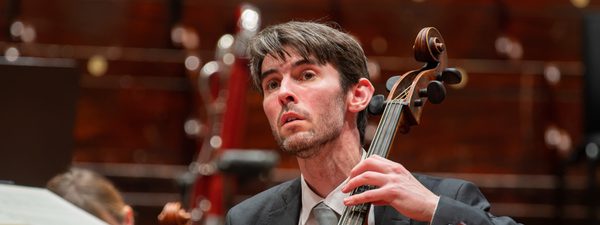
The SCO cellists on Cello Classics: "I thought of the music that we would all relish playing"
4 May 2026
News Story
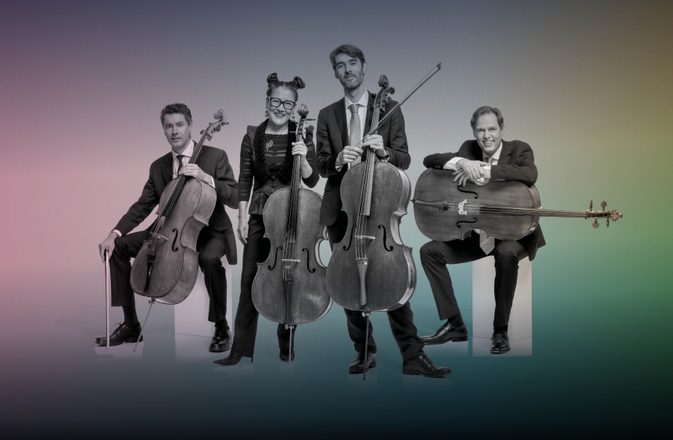
SCO players often step into the spotlight as soloists in the Orchestra's annual Summer Tour. The 2026 vintage takes this further than most, with not one, not two, not even three but all four members of the cello section getting solo spots in a single concert!
Cello Classics has our Principal Cello Philip Higham (who also directs the programme) sharing the stage with each of his colleagues - Sub-Principal Su-a Lee, Donald Gillan (Donnie) and Eric de Wit - in turn for works featuring pairs of cellos. It was the ideal opportunity to have a chat with all four of them about the concert, but we started with some more general discussion about what the Summer Tour means to them.
Philip: We all look forward to it! It’s a chance for us to go to places we don’t normally see, and meet audiences we don’t know so well. And of course, our concerts can be in all kinds of venues, from school halls to small churches or even leisure centres.
Su-a: I remember the very first tour I did, more than 30 years ago. It literally sold the orchestra to me. I was like, "this is what it's all about, to get out into the communities." I remember one concert in Ballachulish, the hall was so small that the orchestra outnumbered the audience. I just thought, "this is so perfect." You feel like you're in a room with all your colleagues, but with people who've come to listen to you and have fun. I love the fact the Orchestra does this, it's a very special part of the year.
Philip: In some of these smaller towns and villages you see whole families coming to the concerts, often with young children, which is so nice to see.
Su-a: One year, I remember going up Blà Bheinn on Skye, and at the top of the mountain, bumping into some folk and chatting. They were very interested in the fact that I was about to do a concert that evening. I invited them along and sure enough, they showed up. It sort of feels like you're kind of part of the Highland scene already by the time you get out there.
Donnie: Our concert is very much an East Coast tour. We're going to Greyhope in Torry, which we haven't ever been to, as far as I know, and the same goes for Nairn.
Speaking of Cello Classics, how did the programme come about?
Philip: I wanted to do something that really showcased each of my three colleagues, who are equally wonderful but distinctly different from each other.
Was there a lot of discussion about what pieces you would play, how they would all combine?
Donnie: Not that I was aware of. Philip just said "I've got an idea," and he came up with the repertoire suggestions.
Su-a: It was just like this explosion of joy, because of the fact that he had thought about it in the first place, and we all feel just really valued and included.
Philip: I was more than delighted that you were all on board for it!
Donnie: The four works are super contrasting, very different styles.
How did you set about selecting them?
Philip: I think the Vivaldi Double was the original idea, but then I started thinking, 'what if you could build a programme around that, with other doubles that would include everyone?' I just thought of the music that we would all relish playing the most. It wasn't long before I remembered the marvellous Violoncelles, Vibrez! by Giovanni Sollima, and in the same moment I thought 'who better than Su-a to play its soaring, sweeping music?'
Su-a: I need to dust off the top end of my fingerboard!
Philip: And it was clear that I wanted to play the Vivaldi with Eric, because of his baroque cello experience. And then after a bit of searching I came across the Suite by Gian Carlo Menotti, a composer whose music I hardly know, but who I remembered actually spent much of his life in Scotland. It's a really fun piece to play, and a mixture of neo-baroque style and Romantic lyricism. There's also a capriciousness to it, in the last movement especially, that reminds me of Poulenc
Donnie: It's quite quirky, with lots of rhythmic wrong-footing. But it's also very expressive, cellistic singing. It's a pleasure to be involved with it.
The cello's very much at the centre of the programme as a whole. Can you tell us about the other pieces you'll be playing?
Eric: It's very nice we've included Arensky's Variations [on a Theme by Tchaikovsky] because the original is a string quartet with two cellos.
Philip: It's a transcription by the composer - a very beautiful work, which we're enjoying looking into as a group - and Britten's Three Divertimenti, an early string quartet we're playing as an orchestra, which will be a lot of fun.
Su-a: If there's anything to come out of this, we've done some cello quartet bits in the past. It's such a joy, and it really feels like we need nobody else. It would be lovely, I think, to put on a program with just the four cellos. There is quite a lot available, but there's also the possibility of arrangements.
There'll be some cello aficionados out there who would love that! Could you give us some examples of pieces this could include?
Philip: Eric is usually my library in this regard! He's especially good at pulling out repertoire that we haven't heard of.
Eric: Well, there's lots of cellists who composed in the 19th century, like Wilhelm Fitzenhagen, who was Tchaikovsky's cellist, and Julius Klengel.
Perhaps we should expect you to go on tour as a quartet at some point, rivalling the 12 Cellists of the Berlin Philharmonic - or maybe you could be their support act?
Donnie: No, they would be our support act!
Related Stories
Classical music on the silver screen
14 October 2026
Join us as we take a close look at the filmic connection in several of our forthcoming concerts.
Craigmillar Residency Shortlisted for 2026 SURF Awards
28 September 2026
The Craigmillar Residency has been shortlisted for the 2026 SURF (Scotland's Regeneration Forum) Awards
Bogdan Božović: "I felt a lot of love and support on the Summer Tour"
15 September 2026
A warm welcome to the Orchestra's new Co-Leader!